You have a business idea, now what?
The Real First Steps (And Why Most People Never Take Them)
You have a business idea.
It’s been living in your head for months. Maybe years. You’ve rehearsed the announcement. You’ve imagined the logo. You’ve pictured the moment it works.
And you haven’t started.
Let’s remove the drama.
You are not lazy.
You are not incapable.
You are not “not cut out for it.”
You are uncertain.
And uncertainty feels like fear.
This is the point where most people stall.
Not because they lack ambition.
Because they lack structure.
So let’s build some.
Step 1: Write It Down Properly (No, Not in Notes App Chaos)
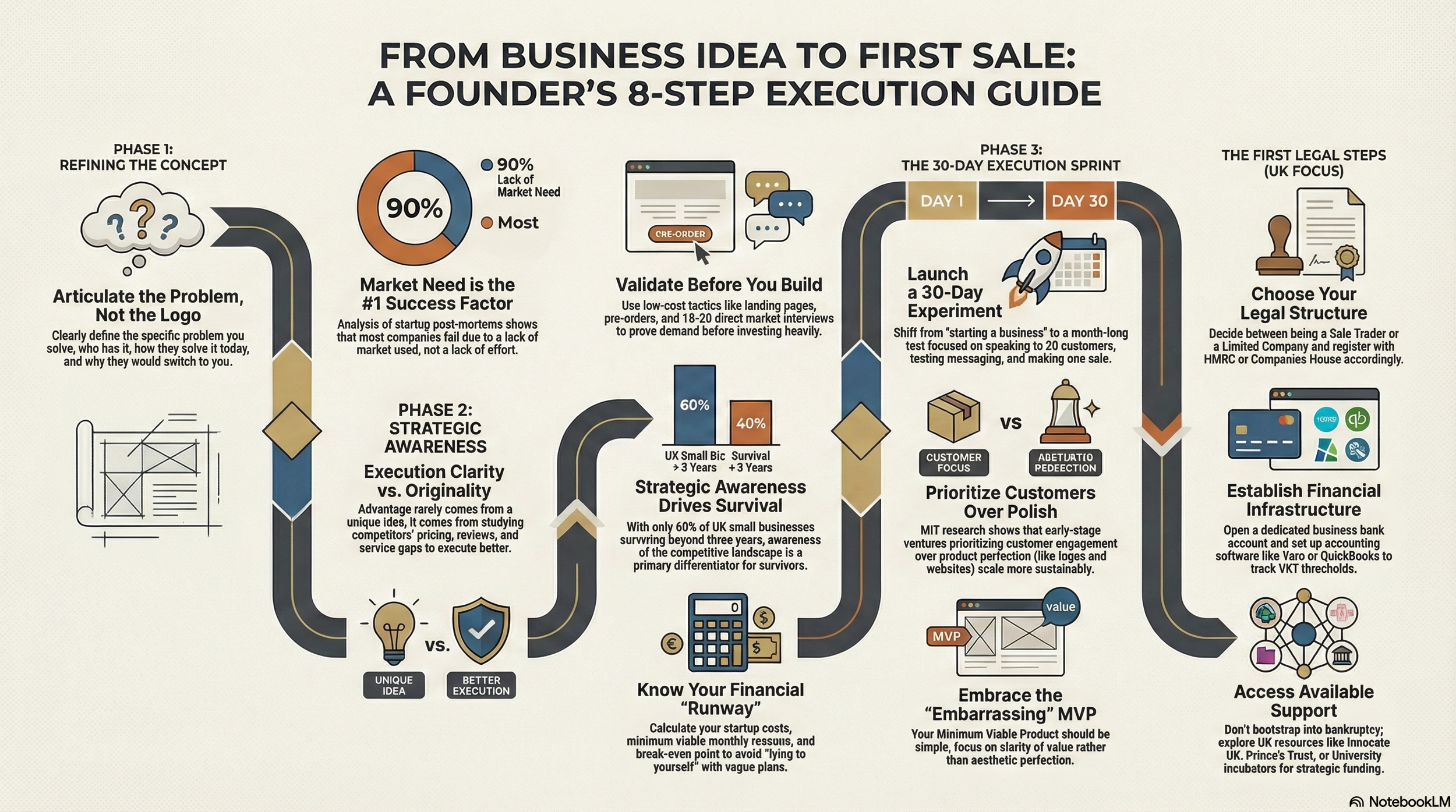
If you cannot articulate your idea clearly on paper, you do not have a business. You have a fantasy.
Write:
What problem does it solve?
Who specifically has that problem?
How are they solving it today?
Why would they switch?
How do you get paid?
If you cannot answer those in plain language, you are not ready to launch — you are ready to refine.
According to research published by University of California, writing goals increases the likelihood of follow-through because it shifts vague intention into defined commitment.
Write it down. Brutally. Clearly.
Step 2: Check If Anyone Actually Wants It
Most start ups do not fail because founders lack passion.
They fail because there is no market demand.
Grantify analysed startup post-mortems and found that the top reason companies fail is no market need.
Not effort.
Not mindset.
Demand.
So validate.
Practical Validation Tactics:
Post the concept in relevant communities and ask for critique.
Run a landing page with email capture.
Offer pre-orders before building.
Conduct 15–20 direct interviews with your target market.
Test ads with a small paid budget (£100–£300).
If no one engages, that is data.
Data is not rejection. It is protection.
Step 3: Study Your Competitors Like a Professional
If you say “I don’t have competitors,” you haven’t researched properly.
Use:
Companies House (UK)
Google reviews
Trustpilot
LinkedIn company searches
Industry directories
Analyse:
Pricing models
Reviews (what customers complain about)
Positioning language
Gaps in service
The Office for National Statistics reports that around 60% of UK small businesses survive beyond three years. The difference is often strategic awareness — not uniqueness.
Your advantage is rarely originality.
It is execution clarity.
Step 4: Understand the Financial Reality (Before It Understands You)
According to the British Business Bank, access to finance remains one of the biggest constraints for early-stage businesses.
So:
Estimate your startup costs.
Estimate minimum viable monthly revenue.
Calculate your runway.
Know your break-even point.
You do not need a 50-page business plan.
You do need numbers that stop you lying to yourself.
Step 5: Explore Grants, Incubators and Support (Stop Pretending It’s Solo)
There is money available.
In the UK for example, explore:
Innovate UK
Start Up Loans Company
Prince's Trust
Local enterprise partnerships
University incubators
Many founders skip this because pride whispers:
“I’ll bootstrap it.”
Bootstrapping is admirable.
Bankruptcy is not.
Use support strategically, when you need it, you need it.
Step 6: Decide What You Are Willing to Lose
This is where mindset gets real.
Starting a business risks:
Income stability
Reputation
Social comfort
Identity
Behavioural economists like Richard Thaler highlight how loss aversion influences risk behaviour. Humans feel losses more intensely than gains.
So your fear is not weakness.
It is wiring.
Write down what the worst realistic outcome is.
Then write how you would recover.
Clarity reduces anxiety.
Step 7: Set a 30-Day Execution Window
Do not “start a business.”
Start a 30-day experiment.
In 30 days you will:
Validate demand
Speak to 20 potential customers
Build a simple landing page
Outline pricing
Test messaging
Make one sale (even discounted)
This removes existential weight.
It becomes action, not identity.
Step 8: Stop Building for Applause
The biggest early-stage mistake?
Polishing instead of selling.
Logos. Websites. Colour palettes.
According to MIT Sloan School of Management research, early-stage ventures that prioritise customer engagement over product perfection scale more sustainably.
Your MVP should be embarrassing.
Your clarity should not.
The Brutal Truth Most People Avoid
You are not scared of failing.
You are scared of finding out you are average.
That is the ego conversation no one has.
But here is the counterweight:
Starting forces growth.
Even if the business fails, you will not be the same person after 12 months of execution.
That is compounding.
The First Legal Steps (UK Focus)
If you are UK-based like I am:
Choose structure (sole trader vs limited company)
Register with HM Revenue and Customs
Register with Companies House if forming Ltd
Open a business bank account
Understand VAT thresholds
Basic accounting software (Xero, QuickBooks)
Do not overcomplicate, do whatever the local version is for non UK people.
Internal Reinforcement
If you feel “behind,” read THIS.
If you are stuck in hustle mode: THIS.
Starting well matters more than starting loudly.
Final Word
The difference between people who start and people who talk about starting is rarely intelligence.
It is structure plus tolerance for discomfort.
You do not need more inspiration.
You need the next defined step.
Write it down. Validate it. Test it. Adjust it.
And stop pretending thinking counts as progress.